Most hiring journeys start with good intentions: a team needs support, a role opens up, or a new business opportunity emerges. But somewhere between that moment and the final offer, one thing often gets overlooked: the job ad.
A job ad isn’t just an announcement. It’s often a candidate’s first emotional connection to your organization. It sets the tone, shapes expectations, and can either welcome people in… or quietly push them away.
Many HR professionals and partners tell us the same thing:
“We want more of the right candidates, not just more candidates.”
And the job ad plays a crucial role in making that happen.
Let’s explore how to write job ads that feel human, inclusive, and aligned, and that help people see themselves thriving in the role.
Start with what matters: Purpose before tasks
Strong job ads begin with purpose.
Not: “We need someone to manage projects.”
But: “We’re looking for someone who can help us deliver meaningful outcomes for our customers by guiding projects from idea to implementation.”
Purpose helps candidates self-select. It inspires the right people and filters out the wrong ones. Research from leading HR sources shows that clarity around role purpose significantly improves applicant fit and reduces misalignment later in the process.
Candidates today want to know why the role exists, not just what they’ll do. So instead of leading with tasks, start with the story:
- What impact will this role make?
- How does it help the team succeed?
- Why is this role important right now?
Focus on outcomes, not task lists
Ever seen those job ads that read like a never‑ending grocery list?
Candidates often skim these or feel discouraged if they don’t match every single line. Outcome‑based job ads are more engaging because they describe what success looks like, not just what fills the day.
For example:
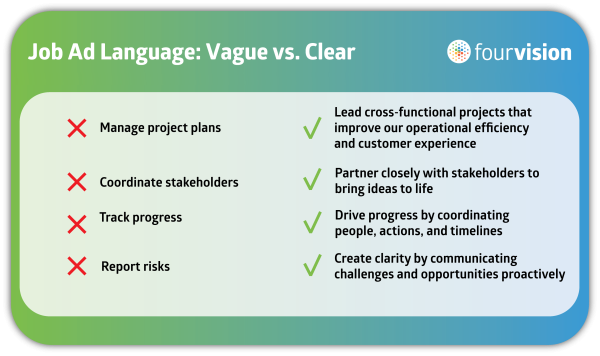
Outcome‑based descriptions show candidates how their success will be measured, not just what will fill their day.
Keep skills essential, inclusive, and realistic
The strongest job ads list only what’s truly needed.
Studies from HR industry publications emphasize that overly detailed requirement lists discourage applicants, particularly underrepresented groups who tend to apply only when they meet nearly all criteria. When companies simplify, they get a wider, more diverse, and more qualified applicant pool.
Good practice for skills:
- Limit must‑have skills to 3–5
- Avoid vague terms like “rockstar,” “unicorn,” or “guru”
- Remove unnecessary degree requirements unless legally or operationally essential
- Separate nice‑to‑have from critical
This small shift invites great talent who might otherwise hesitate.
Tell the human story: Team, culture, and collaboration
People don’t just join a job, they join a community.
A strong job ad includes:
- Who they’ll collaborate with
- How the team works
- The values that shape the team
- What kind of energy and mindset thrives here
Keep it warm, honest, and human. This helps candidates feel the human heartbeat behind the role.
Be transparent about the practical details
Candidates want clarity. Clear ads reduce anxiety, mismatched expectations, and unnecessary back‑and‑forth.
Include:
- Working location (remote / hybrid / onsite)
- Time‑zone expectations
- Contract type
- Language requirements
- Legal entity
- Approximate hiring timeline
- Salary range, especially crucial for EU markets
Transparent job ads increase trust and lead to higher‑quality applicants.
And speaking of salary…
Prepare for EU salary transparency (June 2026)
From June 2026 onward, the EU Salary Transparency Directive requires:
- Salary ranges in job postings
- A ban on salary‑history questions
- Gender‑neutral job descriptions
- Employee rights to request pay comparison data
- Mandatory pay assessments for companies with 100+ employees
To support organizations preparing for these changes, Advanced HRM already includes structured fields, inclusive templates, and salary‑range options that align with these expectations. This ensures your job ads stay fair, compliant, and future‑ready.
Write with global accessibility in mind
A GEO‑ready job ad uses:
- Clear, simple language
- Short paragraphs
- Easily translatable terms
- Consistent structure
- Neutral phrasing free of local idioms
This ensures your job ad is understood equally well in Amsterdam, Berlin, São Paulo, Nairobi, and beyond.
Close with an invitation, not a demand
Instead of ending with a rigid call-to-action: “Apply only if you meet all requirements.”
Try: “If you see yourself in this role, even if you don’t meet every requirement, we’d love to hear from you.”
This small shift improves inclusivity and encourages people with the right potential (not just the perfect résumé) to apply.
If you’d like a simple, ready-to-use guide to put these ideas into practice, you can download our Job ad writing checklist here.